Intermediate & Advanced Training
As students progress beyond the beginner level, training becomes more personalized, refined, and comprehensive. While there are traditionally separate Intermediate and Advanced levels, we combine much of the curriculum to encourage continuous growth and development.
At this stage, students deepen their understanding of Wude (武德), the Code of Martial Ethics, through the physical, mental, emotional, and family-centered aspects of traditional Kung Fu practice.
Training focuses on preserving the skills learned at the beginning stages while developing leadership, initiative, creativity, mentorship, and personal responsibility. Our ultimate objective is to help students build a lifelong foundation for both martial arts excellence and the pursuit of Self-Mastery.
Forms and Sets Training
Forms training develops coordination, body awareness, martial application, and internal control.
Students work toward:
- Improved spatial awareness
- Smooth transitions between postures
- Balance and body control
- Efficient stamina management through breath control
- Synchronization of the eyes, body, and breath
- Visualization and Chi development
- Increased precision, timing, and focus
Forms and Sets Studied
Foundation Forms
- Salute (莊頭)
- Small Cross (小十字)
- Butterfly (蝴蝶拳)
- Combination Black Bird (小燕拳)
- Koon Hung Palm (觀音掌)
Exercise Forms
- Exercise Form 1 (練習拳1)
- Exercise Form 2 (練習拳2)
- Exercise Form 3 (練習拳3)
Partner Sets
- Empty Hand vs. Empty Hand (空手對空手)
- Double Head Stick vs. Double Head Stick (雙頭棍對雙頭棍)
Animal Forms
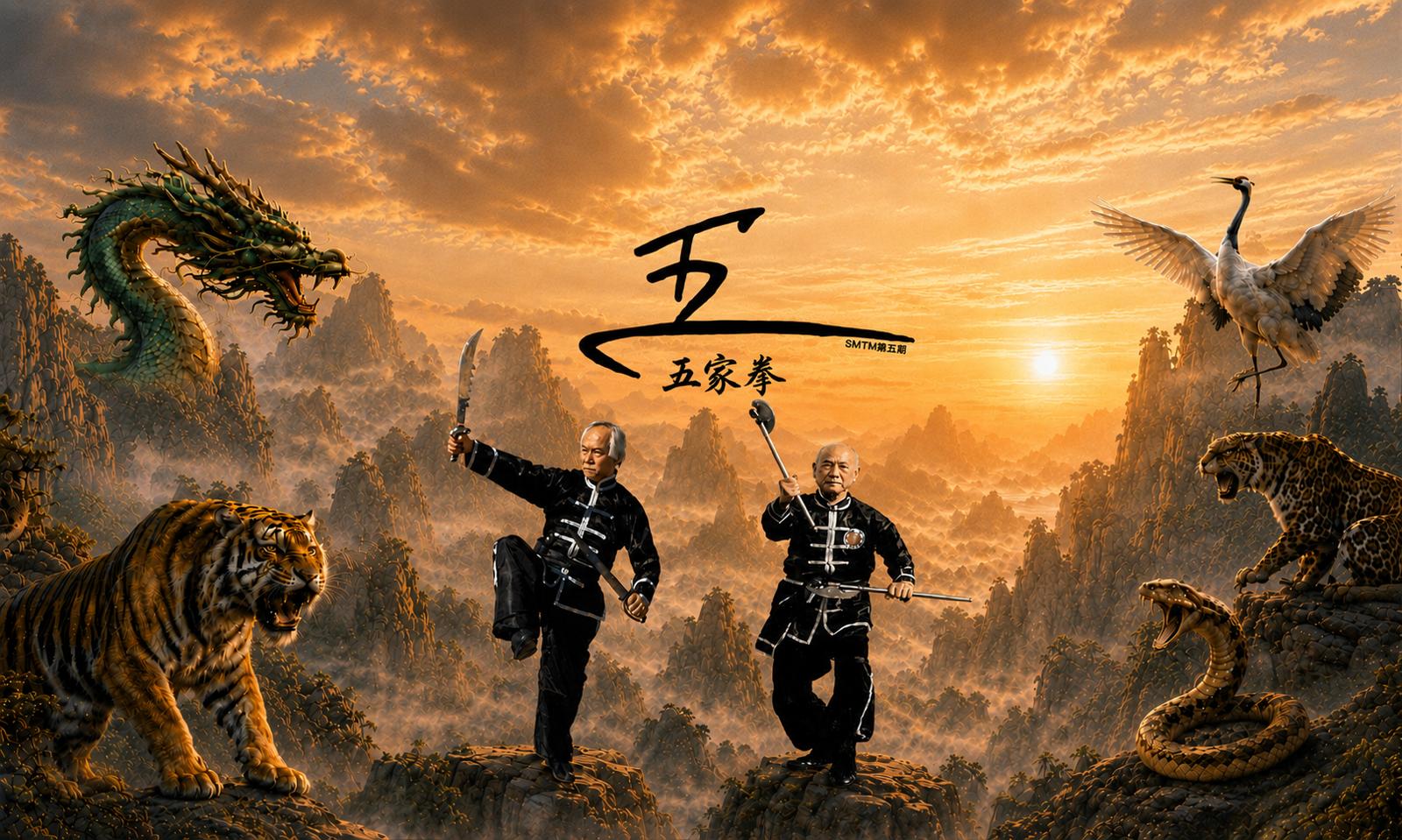
- Dragon (龍形拳)
- Snake (蛇形拳)
- Tiger (虎形拳)
- Leopard (豹形拳)
- Crane (鶴形拳)
- Lion (獅形拳)
- Elephant (象形拳)
- Horse (馬形拳)
- Monkey (猴形拳)
- Panther (彪形拳)
- Eagle 1 & 2 (鷹拳1,2)
- Bull 1 & 2 (牛角拳1,2)
Advanced Hand Forms
- Furious Tiger (威虎拳)
- Tiger Descends the Mountain (猛虎下山)
- Tiger Dragon (龍虎拳)
- Black Dragon (黑龍拳)
- Golden Dragon (金龍拳)
- Side Tiger (側馬虎形拳)
- Gliding Crane (滑翔鶴形拳)
- 18 Sinking Dragon (十八沉龍拳)
Weapon Forms
- Double Head Stick (雙頭棍)
- Butterfly Knives (刀盾)
- Spear (櫻槍)
- Green Dragon Straight Sword (青龍劍)
- Long Pole (左棍)
- Left and Right Hand Long Pole (左右長棍)
- Single Dagger (單小刀)
- Quan Dao 1 & 2 (關刀)
- Three-Section Staff 1 & 2 (三節棍)
- Three-Section Staff vs. Spear 1 & 2
- Traveling Dragon Sword (游龍劍)
- Golden Dragon Sword (金龍劍)
- Steel Whip Chain (鐵鞭)
- Big Sweeper (大掃子)
- Nine Ring Broadsword (九環刀)
- Tiger Hook Sword (虎頭勾)
- Horse Chopper Sword (斬馬刀)
- Single Steel Fan (單鐵扇)
- Double Broadsword (雙刀)
- Tiger Fork (虎叉)
- Single Axe (單斧)
- Double Axe (雙斧)
- Single Broadsword and Shield (單刀盾)
- Butterfly Knife and Shield (蝴蝶刀盾)
- Double Cymbals (雙鈸)
- Monk Spade (方便鏟)
- Rope Dart (繩鏢)
- Rope Meteor (流星繩球)
- Tornado Broadsword (龍捲風刀)
Martial Application
Students learn how each posture, technique, and movement can be applied in realistic martial situations.
Key learning objectives include:
- Understanding the purpose behind every movement within a form
- Applying techniques with training partners
- Recognizing multiple uses for a single movement
- Developing adaptability during transitions
- Preserving the essence of the Five Family system while expressing personal creativity
As students gain experience, they are encouraged to create their own forms while maintaining the principles and foundations of Ng Ga Kuen.
Conditioning Training
Traditional conditioning develops strength, durability, endurance, and body awareness while promoting long-term health.
Training methods may include:
Upper Body Conditioning
- Three-Star and Five-Star arm conditioning
- Shoulder conditioning
- Various push-up methods
- Knuckle, fingertip, palm, and reverse-palm training
- Impact training and bag work
Lower Body Conditioning
- Horse stance training
- Leg strengthening drills
- Partner and self-conditioning methods
- Kicking and impact bag training
Iron Palm and Grip Development
- Palm conditioning
- Finger strengthening
- Tiger-claw training
- Specialized grip exercises
Body Conditioning
- Neck training
- Abdominal and back conditioning
- Foot, shin, heel, and edge-of-foot conditioning
Face and Eye Training
- Drills designed to improve focus, confidence, and awareness while maintaining visual control
Breathing Training
Breathing is a fundamental component of traditional Kung Fu.
Students will learn:
- The difference between conscious and unconscious breathing
- Six traditional breathing methods
- The Ng Ga Kuen breathing exercises
- How breath affects power generation, endurance, and internal control
- The purpose and benefits of conscious breathing in training and daily life
(Reference: The Secret of Kung Fu by Ark Y. Wong)
Offensive Training
Students develop a complete understanding of offensive martial skills, including:
- Striking techniques
- Kicking techniques
- Sweeps and takedowns
- Chin Na (joint locking and control methods)
- Combination attacks
- Timing and distance management
Defensive Training
Defensive training develops awareness, efficiency, and adaptability.
Students learn a variety of defensive methods, including:
- Outside Blocks
- Slapping Blocks
- Cut or Chop Blocks
- Hammer-Fist Blocks
- Hook Blocks
- Upward Blocks
- Knee Blocks
- Arm and Wrist Blocks
- Elbow Blocks
Training also includes understanding:
- Inside and Outside Gates
- Upper, Middle, and Lower Gates
- Left and Right Gates
- Long, Middle, and Short Fighting Ranges
Wooden Dummy Training
Wooden Dummy training is utilized to refine:
- Structure and alignment
- Distance awareness
- Timing
- Power generation
- Gate theory
- Close-range fighting concepts
Formless Training
Formless training encourages creativity while preserving traditional principles.
Students create a personal form that demonstrates:
- Five Family system concepts
- Intentional movement
- Martial application
- Creativity and self-expression
- Understanding of Ng Ga Kuen principles
Two-Person Fighting Sets
Partner training develops timing, distance, coordination, and realistic application.
Examples include:
- Empty Hand vs. Empty Hand
- Empty Hand vs. Weapons
- Butterfly Knife vs. Empty Hand
- Dagger and Short-Stick applications
- Structured combat drills
Weapons Training
Students gain experience with a wide range of traditional weapons, including:
Long Weapons
- Staff (Nangun)
- Spear
- Long Pole
- Quan Dao
- Tiger Fork
- Monk Spade
Medium Weapons
- Broadsword
- Straight Sword (Gim)
- Double Swords
- Nine Ring Broadsword
- Tiger Hook Swords
Short Weapons
- Butterfly Knives
- Daggers
- Axes
- Fans
- Cymbals
Flexible Weapons
- Three-Section Staff
- Steel Whip Chain
- Rope Dart
- Rope Meteor
Specialized two-person weapon sets include:
- Staff vs. Staff
- Broadsword vs. Spear
- Three-Section Staff vs. Spear
Sparring
Sparring allows students to apply their training in a controlled environment.
Goals include:
- Developing muscle memory
- Improving reflexes and reaction time
- Understanding timing and positioning
- Learning movement under pressure
- Maintaining calmness and emotional control
- Applying techniques safely and effectively
Leadership and Mentorship
As students advance, they are encouraged to become role models within the school community.
Leadership development includes:
- Assisting instructors with beginner students
- Leading forms and group practice sessions
- Sharing knowledge with Kung Fu brothers and sisters
- Demonstrating integrity, responsibility, and respect
Traditional Lion and Dragon Dance (Optional)
Lion and Dragon Dance has historically been an important part of traditional Kung Fu culture.
Students may choose to participate in:
- Lion Head
- Lion Tail
- Drum
- Gong
- Cymbals
- Monk Character Performance
Participation helps students develop teamwork, coordination, rhythm, cultural appreciation, and community spirit.

