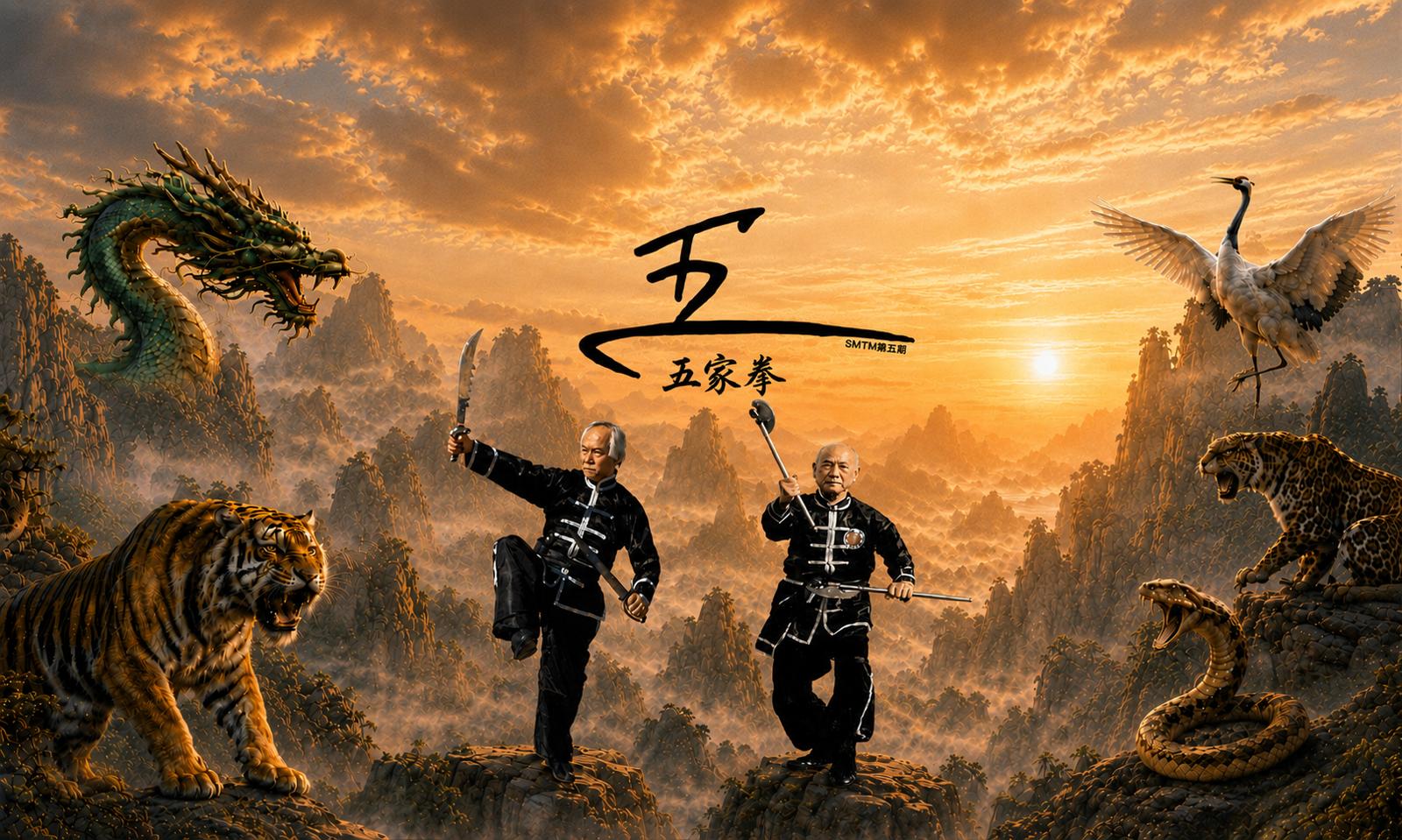
⭐ 5‑Family System (五家拳)
A Practical, Balanced, and Traditional Southern Shaolin Method
The 5‑Family System (Ng Ga Kuen / 五家拳) is a Southern Shaolin martial art built on simplicity, practicality, and efficiency. Although many martial arts share similar roots, Ng Ga Kuen distinguishes itself through three core training pillars:
- Power & Strength (六劲)
- Combat Concepts (六战)
- Breathing Rhythms (运气手法)
Together, these create a complete system that is direct, adaptable, and effective for real‑world application.
⭐ 1. Six Ways of Ng Ga Power / Strength (五家六劲)
Power (jing) is present in every form and movement. Students learn not only how to generate force, but how to deliver it with precision, structure, and intent.
In foundational sets such as Siu Sup Gee (Small Cross), you can observe all six of these expressions:
- Hard (刚) — Strong, committed force (e.g., block and punch).
- Soft (柔) — Circular, flowing movements (e.g., two‑hand circular motion into chin‑na).
- Abstract (虚) — Transitional, deceptive, or empty movements (e.g., cat stance shifting into straight stance).
- Solid (实) — Rooted, stable posture with full-body power (e.g., straight stance punch).
- Straight (直) — Direct linear force (e.g., straight punch).
- Cross (横) — Horizontal or crossing power (e.g., two‑palm strike).
These six expressions help students understand how posture, structure, and intention shape the quality of their power.
⭐ 2. Six Ways of Ng Ga Combat Concepts (五家六战)
Ng Ga Kuen emphasizes simple, efficient, and practical combat principles. Each concept teaches students how to respond to an opponent with clarity and purpose.
- Striking — Fists, feet, elbows, knees; always using the shortest path to the target.
- Blocking — Close‑quarters defensive structures.
- Locking / Grappling / Controlling — Immobilizing or restricting an opponent’s movement.
- Sweeping — Disrupting balance to create openings.
- Redirecting — Using the opponent’s force against them.
- Vital Strikes — Identifying weaknesses and targeting vital points to end conflict quickly.
These concepts form the tactical foundation of the system.
⭐ 3. Six Ways of Ng Ga Breathing Rhythms (五家运气手法)
Breathing is essential for power, endurance, and internal development. Ng Ga Kuen trains six breathing methods, each supporting different aspects of movement and energy control.
Importantly, all breathing exercises can be practiced in any posture — standing, sitting, or lying down — making them accessible for beginners and deeply valuable for long‑term training.
- Abdominal Breathing — Deep belly breathing to expand the lower lungs.
- Attention Breathing — Natural breathing with mindful awareness.
- Reverse Abdominal Breathing — Contracting the abdomen on inhale; expanding on exhale.
- Upper Chest Nose Panting — Rapid nasal breathing focused on the upper chest.
- Abdominal Nose Panting — Rapid nasal breathing coordinated with abdominal contraction.
- The Complete Breath — A full-cycle breath involving inhalation, retention, exhalation, and suspension.
Practiced consistently, these methods help develop:
- a stronger internal structure
- improved circulation
- better stamina
- enhanced recovery
- and a resilient body capable of supporting a long, healthy life
Breathing is not just a technique in Ng Ga Kuen — it is a lifelong tool for wellness.
⭐ A System Built on Practicality and Tradition
Ng Ga Kuen’s structure is intentionally simple:
- Clear categories
- Direct techniques
- Balanced internal and external training
- Progressive conditioning
- Practical combat application
Students learn how to generate power, apply techniques effectively, and cultivate internal awareness — all within a system that has been refined through generations of Southern Shaolin practice.

