

Kung Fu Lineage and Historical Foundations
Kung Fu (功夫), also written as Gong Fu or Gung Fu, is widely recognized as the ancient martial tradition associated with the Shaolin monks of China. Although commonly linked to martial arts, the term originally meant “achievement through hard work and disciplined effort.” By the 19th century, Kung Fu in China referred broadly to any skill developed through dedicated practice, not exclusively combat.
In modern times—particularly after 1949—the term Wushu (中國武術 zhōngguó wǔshù) became the official name for “Traditional Chinese Martial Arts,” emphasizing its role as a national sport and standardized cultural practice. Despite this shift, the deep heritage of Kung Fu continues to reflect centuries of evolution, philosophy, and refinement.
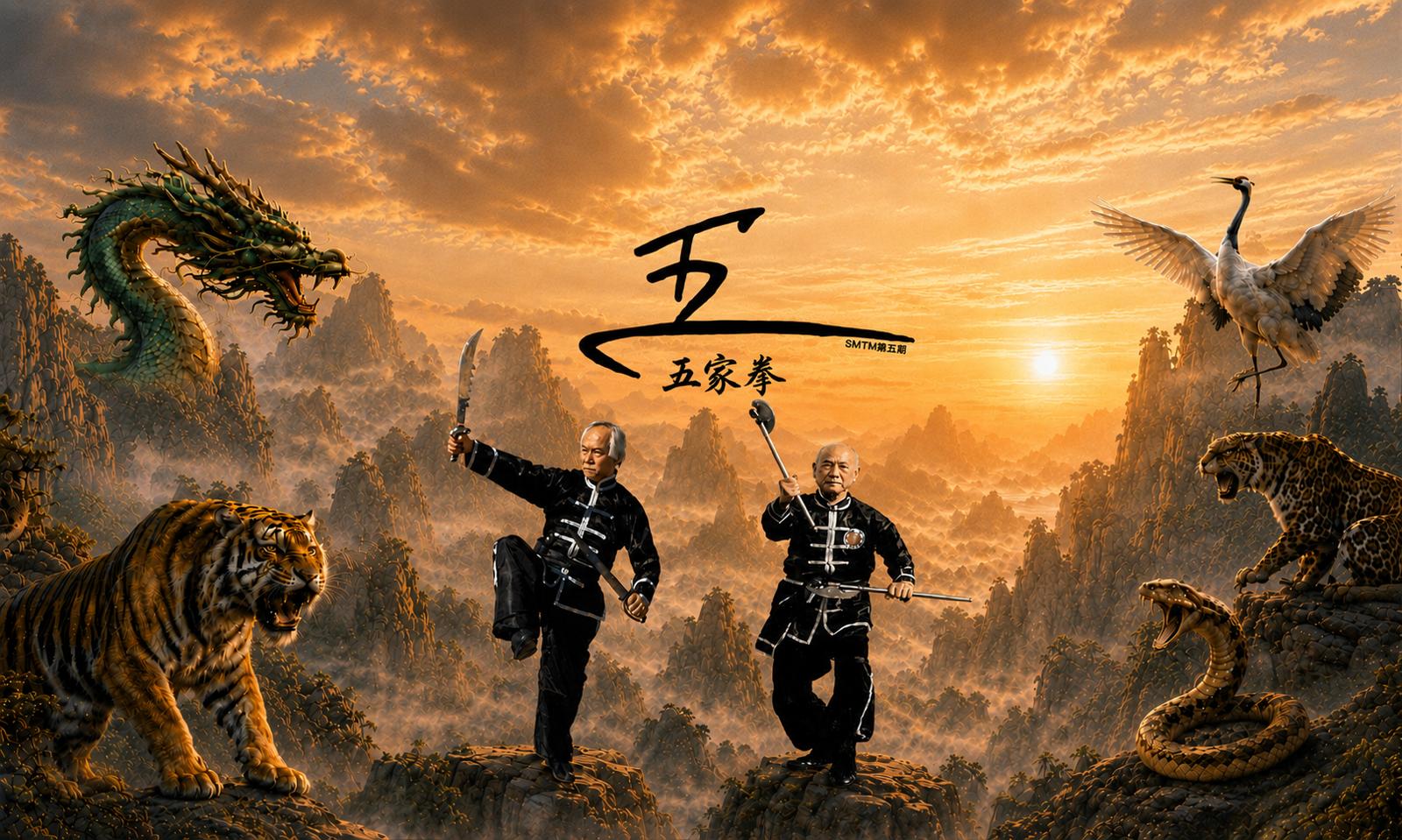
Within the broader Kung Fu tradition, numerous systems and family lineages emerged from Shaolin teachings. Some styles developed through generations of transmission; others evolved by combining methods, principles, and philosophies from multiple arts. The Ng Ga Kuen (Five Family Fist) system is one such lineage, incorporating elements from several traditional family styles—including Fut Ga, Hung Ga, Choy Ga, Lee Ga, and Mok Ga—each contributing unique structures, postures, and combat strategies.
Understanding Differences Among Kung Fu Styles
The following overview highlights ten well‑known Kung Fu styles, offering a broad perspective on their defining characteristics and training approaches.
Shaolin & Wudang — Yin and Yang in Martial Arts
Shaolin (外家 Wai Jia, external school) and Wudang (內家 Nei Jia, internal school) represent two major branches of Chinese martial arts. Both embody the Daoist philosophy of Yin and Yang, expressed through their balance of hardness and softness, motion and stillness.
- Shaolin emphasizes strength, speed, explosive power, and physical conditioning—attributes of Yang. Yet it also cultivates Yin qualities through breath control, stance training, and internal focus.
- Wudang begins from Yin, prioritizing softness, intention, internal energy (Qi), and fluid movement. Its systems—such as Tai Chi, Xing Yi, and Bagua—blend softness with hidden strength and stillness with dynamic motion.
True mastery transcends the distinction between internal and external, seeking harmony between mind and body, Yin and Yang, and ultimately achieving “action through non‑action.”
Shaolin Five Animals — Expressions of Yin and Yang
Shaolin’s Five Animal system integrates animal attributes with philosophical principles:
- Tiger — Fierce, forceful, offensive; pure Yang
- Dragon — Flowing, powerful, intentional; Yin‑Yang unity
- Leopard — Fast, explosive; pure Yang
- Snake — Smooth, agile, soft overcoming hard; Yin
- Crane — Balanced, calm, harmonious; Yin with Yang
Through Five Animal training, practitioners develop movement, power, intention, breath, and internal‑external unity.
Overview of Major Kung Fu Styles
Wudang (Internal)
Focuses on cultivating Qi through fluid movement, balance, and intention. Includes Tai Chi, Xing Yi, and Bagua.
Southern Five‑Family / Five‑Animals (External)
Emphasizes strength, speed, and powerful techniques inspired by tiger, crane, leopard, snake, and dragon.
Choy Li Fut (Hybrid)
Combines Northern and Southern methods, featuring circular strikes, agility, and long‑range versatility.
Wing Chun (External)
Specializes in close‑range efficiency, centerline theory, simultaneous attack and defense, and practical self‑protection.
Hung Gar (External)
Known for strong stances, powerful strikes, and tiger‑crane techniques. Builds physical strength and foundational stability.
Shaolin Kung Fu (Internal/External)
One of the oldest systems, blending rigorous conditioning, acrobatics, powerful strikes, and mental discipline.
Baguazhang (Internal)
Characterized by circular walking, fluid motion, and evasive footwork. Generates power from continuous movement.
Xing Yi Quan (Internal)
Uses direct, linear strikes powered by internal energy and natural body alignment.
Praying Mantis (External)
Inspired by the insect’s movements; emphasizes speed, precision, trapping, and joint manipulation.
Eagle Claw (External)
Focuses on gripping, seizing, joint locks, and pressure‑point attacks with strength and precision.
Continuing Your Journey
The world of Kung Fu is vast, diverse, and deeply philosophical. Continue your research, explore the lineage, and deepen your clarity. Each style offers its own wisdom—and Ng Ga Kuen carries the combined strength of five families and five animals, unified through generations of traditional Shaolin teaching.

