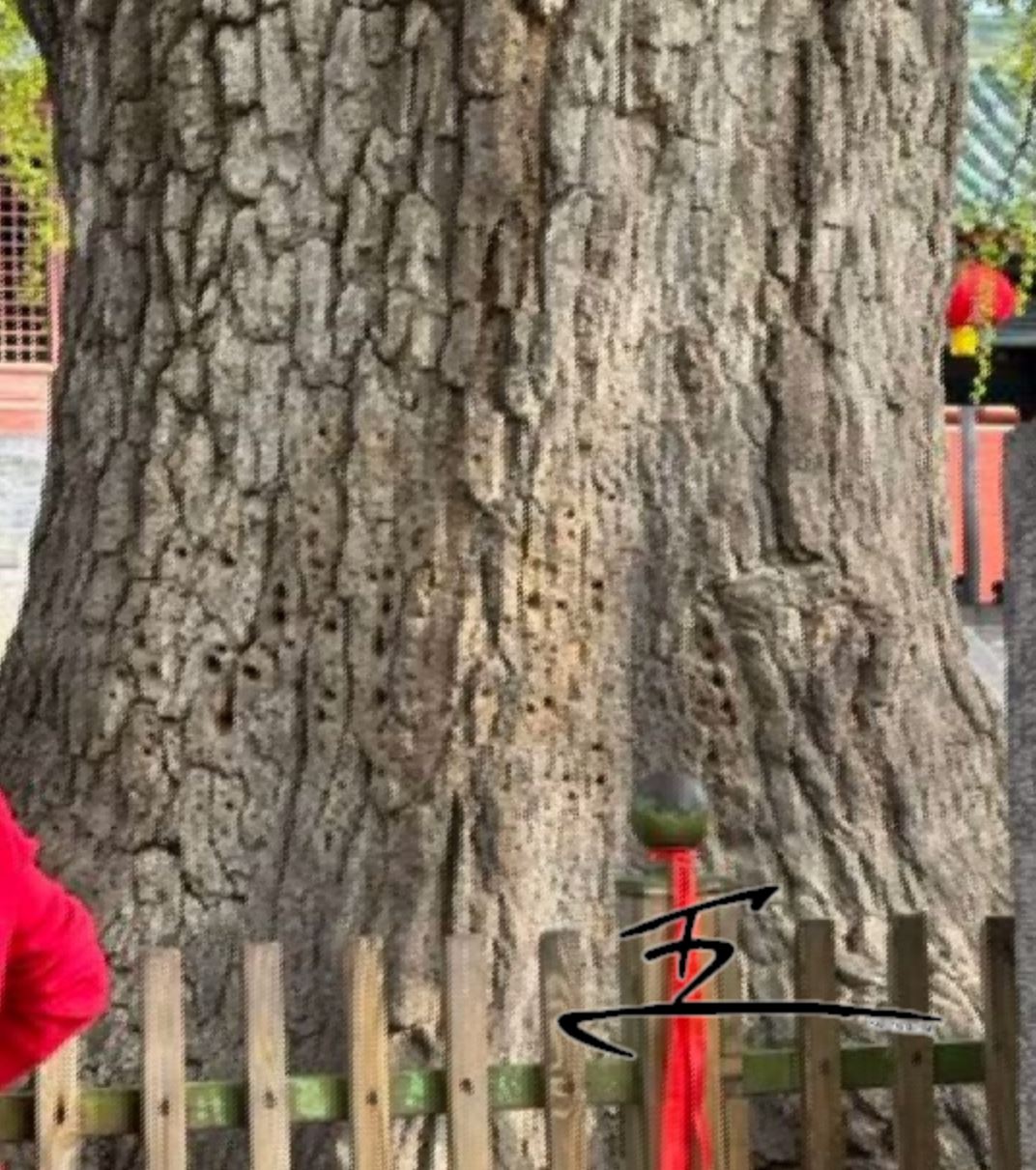
Thousand Year old tree with holes were for finger training by high ranking monks at the Shaolin Temple.
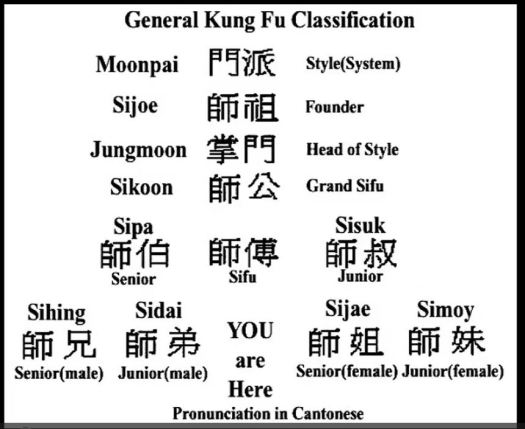
A Brief Traditional Chinese Hierarchical Familal Classification
Understanding Discipleship
Another good source / description on Discipleship > Shaolin Temple.
A good article that describes “Discipleship” is presented on the New Life Kung Fu website, with the majority of it being referenced as it relates to the NGK practices, but the link is provided for you convenience: “Discipleship What is a Disciple?”
“Within Chinese culture, any traditional skill may be passed down from master to disciple, whether it be martial arts, scholarly arts, painting, cooking, even the art of being a barber or an executioner. Becoming a disciple forges a unique bond between you and the long line of ancestors who forged your tradition before you. It is a very special relationship between master and disciple, full of ritual and meaning. You become family. However, like so many aspects of Chinese culture, it is woefully misunderstood by outsiders.
Traditionally, Chinese disciplines do not have a “black” belt system of hierarchy. The belt (or dan) tradition comes primarily from Japan. Like the Chinese system, dan traditions also extends beyond martial arts to other disciplines like tea ceremony or the game of Go. In contrast, the Chinese system is more familial, than militaristic. The term we use for master is Sifu, which also implies “father”. In the same fashion, other titles translate literally into “elder brother”, “younger sister”, “uncle”, and so on. This system is not exclusive to martial arts. These same terms might be used in any community, from fellow workers in the same company to organized crime triads. It is important to note that a term like “big brother” (Sihing in Cantonese) can have two meanings. It could mean either a member who joined the community before you or a member who is physically older than you. This distinction depends upon the preference of the Sifu.” In the NGK practices, we have adopted a color ranking system that aligns with the tradition to allow the art to expand in a modern world.
“Chinese people hold teachers in very high regard. A Chinese student will always hold a special loyalty for any previous teacher, even if they only studied with them once. Accordingly, there are some particular observances of respect unique to the pedagogical context. To begin, every student submits unquestionably to their teacher. They must be willing to “empty their cup” of any previous misconceptions and accept the new teachings no matter how disruptive they may be to their personal world view. This is just one reason why it is important to begin with a good teacher. Submission is often represented symbolically by the simple ceremony of “bowing to the teacher”. Almost every student begins with this basic teacher-student relationship, the “general public” class. These students are called Moon Sang or “in the door”. In the martial arts, most teachers have many students, especially now in modern times.”. GM Ark Y. Wong and Sifu Seming Ma have carried the NGK teachings for over a century, teaching many thousands of students, which would be considered “in the door” students.
“Discipleship is a more intimate relationship, akin to marriage. Two people make bonding vows that will unite them into family forever. Unlike marriage, a Sifu can have many disciples. When a Sifu has hundreds of disciples (and some grand masters have thousands) it is a demonstration of pure political power. Generally, disciples have only one master. Practically speaking, it is difficult to honor all of the tremendous obligations that comes with discipleship for more than one Sifu. Furthermore, in days of old, a Sifu would not want to reveal his “back room” secrets to a disciple of another Sifu. However, in the last century, many people have become disciples of multiple masters.” In the NGK practice, we strongly encourage the disciple-master relationship to only a single master.
“When the student is satisfied with the teacher’s skill and character, they may decide to make a deeper commitment and become a disciple. Formally called Yup Sut Dai Gee (in the back room, skill “son”), this term originates from the architecture of old Kung Fu schools. In old schools, the teacher would commonly teach all of the “in the door” students together in a big hall or courtyard. More intimate instruction for disciples would take place in a private back room. Here, Yup Sut Dai Gee receive special tutelage material from their Sifu, where finer points would be clarified and “secrets” would be revealed. The Yup Sut Dai Gee would represent the Sifu in the public eye, so they were often taught some secret skills. It would be these students that would carry on the school after the Sifu was gone, so they must commit to learning all of the knowledge their Sifu has to offer.”
“It may surprise you to find that a Sifu does not even have to know the student before accepting him or her as a disciple. Sometimes an intermediary can speak for someone the master does not even know. Just like in arranged marriage, an “arranged” discipleship is not uncommon in the East. Such an arrangement may have political overtones, such as alliance between two factions, or it may simply be a good match in the eyes of an industrious intermediary. Many great masters were made disciples because they were given to their Sifu as orphans. This assured that the Sifu would care for the orphan like their own child. While many westerners reject the idea of arranged marriage, many easterners frown equally on the western practice serial marriage (divorcing and remarrying several times). Not surprisingly, many masters are reluctant to take Western disciples because of a perceived lack of the cultural foundation to adhere to such a commitment. Serial discipleship just does not work.”
As a Disciple of Ng Ga Kuen Kung Fu, you are given the title of Moon-to (Specially selected students with a responsibility for carrying on the style – hand- picked students who meet certain criteria)
“A Moon-to gets to assist the Sifu with important decisions for the Kwoon along with instructing Moon-yan and attending belt testing. It is your responsibility as a Moon-to to stay ahead of all Moon-yan.
Sifu: Instructor
Sihing: Senior Kung Fu brother (i.e. one who started before you no matter how old they are)
Si Jie (Sijae): Senior Kung Fu Sister (i.e. one who started before you no matter how old they are)
Sidai: Junior Kung Fu brother (i.e. one who started after you no matter how old they are)
Simui (Simoy): Junior Kung Fu sister (i.e. one who started after you no matter how old they are)
Moon-to: Disciples – specially selected students with a responsibility for carrying on the style – hand- picked students who meet certain criteria.
Moon-yan: Students, followers”
Definition / Terms / Acronyms
NOTE: Many of the Chinese terminology or romanized (pinyin) Chinese words/characters presented on this Website are from the region of China located on the western border of the Pearl River Delta in Guangdong China. The dialect that is mostly used on this Website, so say “Chinese” dialect, or some say the “Cantonese” dialect, but is really it’s own language called Taishanese, Toishanese, Hoisanese, or Hoisan-wa. Yes, very confusing, so we will just say “in Chinese”, or “the Chinese word is” to make it easier for us to communicate. However, the phonetic pronunciation that is passed down is of the Toisanese dialect, which is closely related to Cantonese dialects, however, the Chinese written character used is from the Traditional Chinese language, which is well understood in any of the “Chinese” spoken languages. Note, the Simplified Chinese character-set is usually referring to the Beijing dialect of Mandarin Chinese or Taiwanese Mandarin dialect, which has a different written character-set that the traditional-written Chinese characters. Thus, below are some helpful information for various terms used in our Kung Fu system.
| Term | Meaning | |
|---|---|---|
| Bridge Hand | It is the activity of the initial contact between you and an opponent. In general, bridge hand is for the practitioner to know how and when to bridge the gap between you and your opponent and using a technique (majority techniques are hand) to possibly jam/trap/strike/takedown/lock/etc. your opponent’s limb. Although, the majority of of the techniques are performed with the hand, hence “bridge hand”, there are techniques using the leg, hip, body or even head. | |
| Canton | A Cantonese term referring to the province in Southern China. It is more modernly referred to as Guangdong or Guangzhou. | |
| Chin-na | 擒拿 | Sometimes referred to as Qinna. The techniques are focused on grappling, joint-locking, capture and hold. It is a way to control or lock an opponent’s joints or muscles/tendons so they cannot move, thus neutralizing the opponent’s fighting ability. |
| Choy Ga | “Choy Ga” was also spelled as “Choi Ga”. | |
| Ga | 家) | Also written as “Gar”, which means “family”, “household”, or “home” in Chinese. For example, “Hung Ga” would be “Hung Family”. |
| GM | An acronym for Grand Master. | |
| Gong Fu | Also written as Kung Fu or Gung Fu | |
| Kuen | 拳 | Means “Boxing” or “Fist”. Sometimes written as “Kyun”. |
| Lau Ga | Understood to be the surname of the family that practiced a particular style of Kung Fu, however, in honor the Buddha, the “Lau Ga” was renamed to “Fut Ga”. | |
| Lee Ga | “Lee Ga” was also spelled as “Li Ga” | |
| Mok Ga | “Mok Ga” was also spelled as “Mawk Ga”. | |
| Ng | 五 | Means “5” or “Five” in Chinese. |
| Ng Ga Kuen | 五家拳 | In the context of Martial Arts, it means “Five Family Style” and not “Five Family Fist”, but some people will refer to ng ga kuen as 5-Family Fist. The acronym for Ng Ga Kuen is NGK. |
| Set | A terminology used to refer to as a form or kata. For example: the “Butterfly Set”, or the “Snake Set”. | |
| Sifu | ||
| Sil Lum Gung Fu | This pronunciation is Cantonese for Shaolin Kung Fu. | |
| Wude | Wude is the romanized form of Martial Virtues or Martial Ethical in Mandarin, while it is the same as Mo Duk (Cantonese). It is part of the Martial Arts that transcends the boundaries of self-defense and physical fitness. It embodies a comprehensive philosophy and holistic approach to personal development. Ethical Values and Character Development: Character development is woven into the very fabric of every Martial Arts. Practitioners are expected to embody ethical values such as respect, integrity, truth, humility, and loyalty, both inside and outside their Martial Arts School. | |
 Shaolin Kung Fu - 少林五家拳